

Slurry Hose: Understanding Wear, Flexibility and Application Requirements
Why Slurry Service Is Demanding
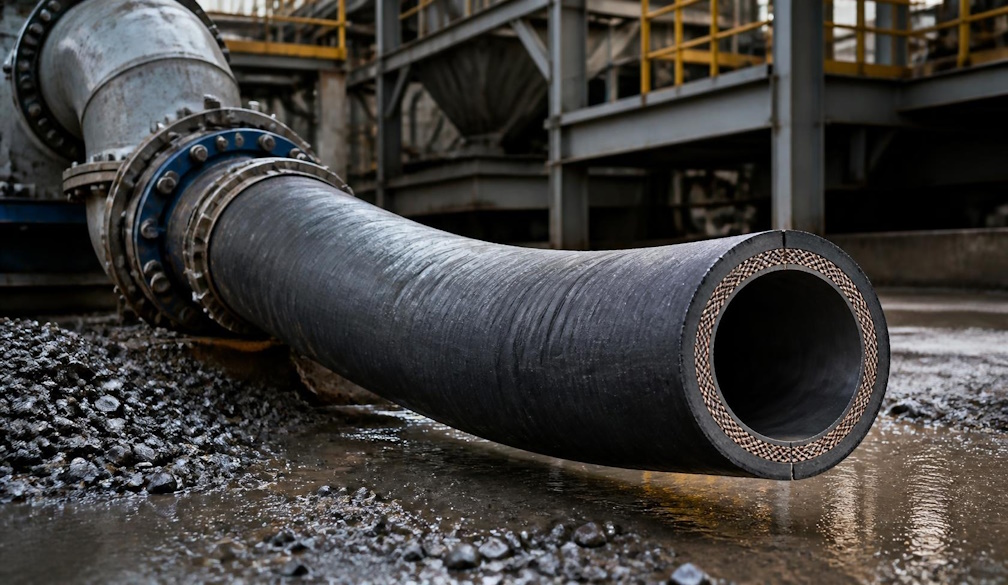
Slurry combines liquid with solid particles, creating operating conditions that can be significantly more abrasive than clean-water transfer. A slurry hose must balance wear resistance, flexibility and operating pressure. The hose must accommodate movement while resisting internal wear. Pacific Flow Technology describes its slurry range as designed for durability, flexibility and high wear resistance in demanding applications.
Abrasion Resistance and Liner Choice
The internal liner is one of the most important parts of a hose carrying abrasive material. A slurry hose must balance wear resistance, flexibility and operating pressure. Pacific Flow Technology offers liner compounds suited to different slurry characteristics, including high-wear applications, fine sands and larger rock slurry. Selecting the liner around the material being conveyed can help address the specific wear mechanism expected in service.
Flexibility Supports Complex Pipework
Mining and processing plants often contain bends, changes in direction and connections between rigid sections. A slurry hose must balance wear resistance, flexibility and operating pressure. A flexible hose can accommodate movement and simplify installation where rigid pipework would be difficult to route. Pacific Flow Technology offers straight hose, preformed bends and other configurations to suit different layout constraints.
Pressure and Vacuum Requirements
The operating duty determines whether a hose needs suction capability, discharge capability or both. A slurry hose must balance wear resistance, flexibility and operating pressure. Hard-wall mining hose products from Pacific Flow Technology can be designed for suction and discharge duty, while other constructions are intended for discharge service. Matching the hose construction to pressure and vacuum conditions is essential before installation.
End Connections Complete the System
Flanges, Victaulic connections, muff couplings and other end arrangements can be used depending on the pipeline and maintenance approach. A slurry hose must balance wear resistance, flexibility and operating pressure. Pacific Flow Technology provides multiple connection options and custom configurations. Considering connection requirements at the design stage can help avoid installation issues and make future maintenance more manageable.
Custom Manufacturing for Difficult Applications
Standard dimensions do not always suit a specialised slurry system. Pacific Flow Technology manufactures custom hose assemblies and can accommodate different lengths, diameters, bends and connections. This allows the hose to be developed around the actual application instead of forcing the installation to fit a standard product.
Building a Better Slurry Transfer System
Reliable slurry transfer depends on selecting a hose around the full application. Abrasion, pressure, vacuum, flexibility, material characteristics and connections all need to be considered together. Pacific Flow Technology's slurry range provides multiple constructions for demanding mining and processing duties, with technical support available to help match the hose to the system.
Maintenance planning is another practical consideration when flexible piping is installed in a demanding environment. Hose sections may eventually need inspection, cleaning, rotation or replacement, depending on the service and site procedures. Providing suitable access around connections can make these tasks easier, while accurate identification of hose size and configuration can simplify future ordering. Pacific Flow Technology offers optional ID tagging on several hose products, which can help with identification within larger installations. Keeping records of hose location, service conditions and replacement history can also give maintenance teams useful information when assessing recurring wear patterns or planning shutdown work. Documentation can be particularly valuable on projects where hoses form part of a larger process system. Recording dimensions, end connections, pressure requirements and the conveyed material creates a reference for future maintenance and replacement. Where a custom assembly is supplied, keeping the original specification can reduce uncertainty when another section is required later.