
When Does a Blocked Stormwater Drain Need Repair Instead of Another Clean?
Stormwater systems naturally need maintenance. Leaves, silt and soil enter pits, roots may grow near pipework, and debris can collect after landscaping or construction. Cleaning these materials out is often all that is required.
The situation changes when the same drain blocks again and again. At that point, stormwater drain repair may be more appropriate than another clean, particularly if inspection shows cracks, displaced joints, deformation or a section that no longer drains correctly.
The challenge for homeowners is knowing when maintenance has crossed into repair territory.
One blockage is maintenance; recurrence is evidence
A single blocked pit after a season of leaf fall may not indicate any fault in the pipe. Once the material is removed and the line is flowing, the system may continue to work normally.
A drain that needs clearing several times in a short period is different. Recurrence suggests there may be a feature inside the pipe that catches material or reduces capacity.
The interval matters. If each blockage occurs sooner than the last, the underlying condition may be worsening or the opening through the obstruction may never have been fully restored.
Keeping a simple record of when cleaning was done and what was removed can make the pattern much easier to recognise.
Roots point to an entry point that cleaning cannot close
Root intrusion is one of the clearest examples of the difference between clearing and repair. Roots can be cut and removed from the pipe, but they entered because moisture was accessible through a crack, joint or other opening.
If the defect remains, root growth can return. The next blockage may take months or years depending on the tree, moisture and size of the opening, but repeated root removal from the same location is evidence that the pipe itself deserves attention.
Repair options depend on the condition of the host pipe. A local excavation may be practical in an open garden. Relining may be considered where the pipe retains its shape and access makes excavation disruptive.
Cracks and displaced joints can trap debris
A crack does not always stop water flow immediately. The problem is that damaged internal surfaces can create places for silt and organic material to catch.
A displaced joint can form a lip inside the line. Water passes over it, but solids settle behind it. Each rain event adds more material until the available opening becomes too small.
Cleaning removes the buildup, but the lip remains. If the same defect repeatedly causes blockage, stormwater drain repair addresses the reason the debris keeps collecting.
A sagging pipe behaves differently from a dirty pipe
Stormwater lines depend on consistent fall. If the ground shifts or support beneath the pipe fails, a section can settle and form a low point.
Water and sediment then remain in that section after rain. Over time, the sediment layer reduces capacity and the line blocks more easily.
Cleaning can remove the sediment, but it cannot restore the pipe to the correct level. Depending on the severity and location, correcting a sag may require excavation and regrading of the affected section.
This is why standing water seen on a camera inspection is important. It can indicate a shape problem rather than simply dirty pipework.
Damage after landscaping or building work deserves investigation
Stormwater pipes can be affected by excavation, heavy vehicles, new driveways and changes to ground levels. A shallow pipe may be crushed or displaced, while an access point can be buried beneath paving or soil.
If overflow begins soon after work around the property, mention it during the inspection. The timing can help narrow the likely area of damage.
The repair may be local rather than extensive. Accurate location is valuable because it allows the plumber to target the affected section instead of opening large areas unnecessarily.
Camera footage helps separate cleaning from repair
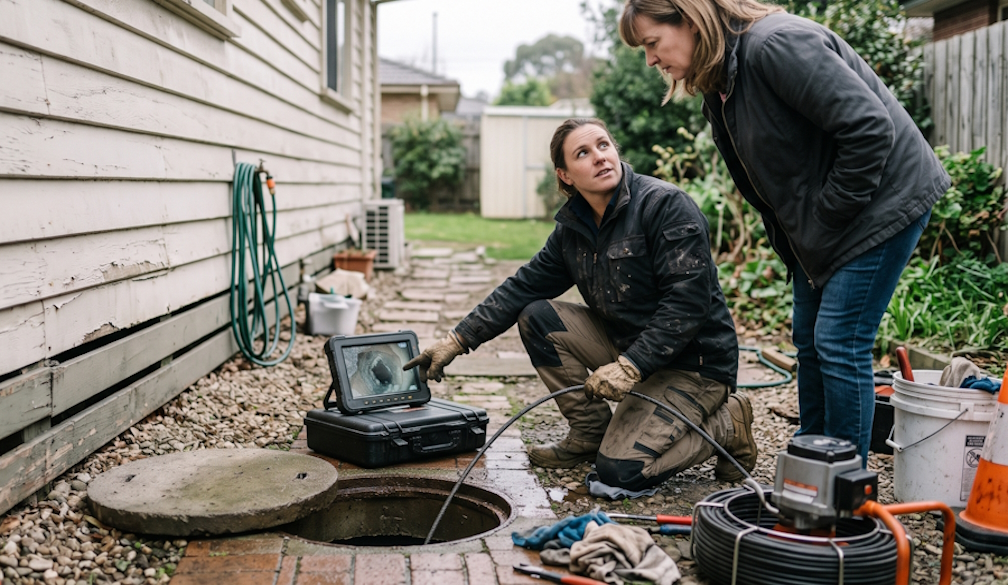
A CCTV inspection is most useful after the line has been cleared enough for the camera to travel and the pipe wall to be seen.
If the footage shows a clean, intact line with no standing water or structural defect, another repair may not be justified. Maintenance and better surface control may be enough.
If the footage shows cracks, root entry, deformation, displaced joints or persistent water retention, there is evidence that the system has a physical problem. At that point, the discussion can move from "How do we clean it again?" to "Which repair method suits this defect?"
Repair method depends on access and condition
There is no single stormwater drain repair that suits every problem. A short damaged section in an accessible garden may be excavated and replaced. A structurally suitable pipe beneath paving may be considered for relining. A badly collapsed line may require replacement because there is not enough remaining shape for an internal liner.
The route, depth, material and surrounding surfaces all affect the choice.
A good recommendation should explain both why repair is needed and why a particular method is appropriate for the actual defect.
Repair can also improve future access and maintenance
When a damaged section is being repaired, it can be worth reviewing whether the system is easy to access for future maintenance. Older properties sometimes have buried or poorly located inspection points, and landscaping can make pits difficult to reach. A repair project may provide an opportunity to improve access or clearly record pipe routes while the area is open.
That does not mean adding unnecessary work. It simply recognises that future cleaning and inspection are easier when the system can be reached without guesswork or avoidable excavation.
Stop measuring success by how long the clean lasts
Some homeowners accept regular clearing as normal because each visit restores flow. That can be reasonable for predictable surface debris, but it is less sensible when the same underground defect keeps generating blockages.
The point of stormwater drain repair is not to eliminate all future maintenance. Gutters, pits and drains will still collect material over time. The goal is to remove structural faults that make the system fail far more often than it should.
If cleaning has become routine because the same section keeps blocking, that is the moment to ask a different question. Instead of wondering when the drain will need clearing again, find out what inside the pipe is making the blockage return.