
Why Granite Remains One of the Most Durable Options for Kitchen Benchtops in Australia
Granite has been in kitchens for decades. It was the dominant premium benchtop material through the late nineties and most of the 2000s, before engineered stone took over much of that market. Today, with quartz composite and sintered surfaces commanding significant market share, natural granite for kitchen surfaces is sometimes described as unfashionable. That description misses the point. Granite is still one of the most capable natural stone options for a working kitchen, and its performance credentials have not diminished simply because the market has moved on to other materials.
In an Australian context specifically, granite's durability profile makes a strong case for itself.
What Granite Is and Why It Performs So Well
Granite is an igneous rock formed from the slow crystallisation of magma deep within the earth's crust. The process takes millions of years and produces a stone with an interlocking crystalline structure that is extraordinarily hard and dense. This is not marketing language. On the Mohs scale of mineral hardness, granite typically sits between 6 and 7, which means it is harder than most metals and resistant to scratching under normal kitchen conditions.
This hardness comes from the quartz, feldspar, and mica crystals that make up the stone. Because these minerals are fused together at the molecular level rather than cemented with a binder, granite does not have weak points in the way that some composite materials do. The hardness is consistent throughout the slab, not just on the surface.
Heat Resistance
One of granite's most practical qualities in a kitchen is its relationship with heat. Granite is formed under extreme temperatures, so a hot pot or pan placed directly on the surface is unlikely to cause any damage. The stone absorbs and distributes heat rather than reacting badly to it.
This is a meaningful difference from many engineered surfaces. Quartz composite is resin-bonded, and that resin can discolour or crack under sustained high heat. Sintered stone handles heat very well, but it is a manufactured product rather than a material that has been exposed to geological-level temperatures for millions of years.
For households where cooking is a serious daily activity and the bench occasionally absorbs the heat of a pot pulled directly from the stove, granite behaves without protest.
Scratch Resistance in Daily Use
Because granite is harder than most utensils and knives used in a domestic kitchen, scratching under normal use is rare. This does not mean granite cannot be scratched, but achieving it requires a deliberate effort or a significantly harder material. For practical purposes, the bench holds up to daily knife use, appliances being slid across the surface, and the general impact of a kitchen in constant use.
This is worth weighing against softer stone options. Marble, for all its beauty, is a relatively soft stone and will show knife marks and scratches more readily than granite over time. Engineered stone varies in hardness depending on the manufacturer and the specific product.
Performance in the Australian Climate
Australia's climate introduces specific demands that granite handles particularly well. In coastal areas, the humidity and salt air that degrade some materials do not affect granite in any meaningful way. The stone does not rust, corrode, or break down in response to moisture.
More relevantly for outdoor kitchen applications, which are genuinely common in Australian homes, granite is one of the few natural stone options that performs reliably in a sun-exposed outdoor environment. Its UV stability means it does not bleach, fade, or change colour under sustained sun exposure the way some other materials do. For a covered outdoor kitchen, granite is one of the most sensible choices available.
Porosity and Sealing
Granite is less porous than marble, which means liquids do not penetrate as readily and the stone is somewhat more forgiving of spills that are not immediately wiped up. That said, it is not impermeable. Quality granite still benefits from sealing, particularly in a kitchen where wine, oil, and acidic liquids are regularly in play.
The good news is that granite typically requires less frequent sealing than marble. Depending on the specific stone and the level of kitchen use, resealing once a year may be sufficient where marble might need it twice or more. The water bead test used for marble applies equally here: if water stops beading on the surface and starts absorbing, the sealer needs refreshing.
The Range Available Today
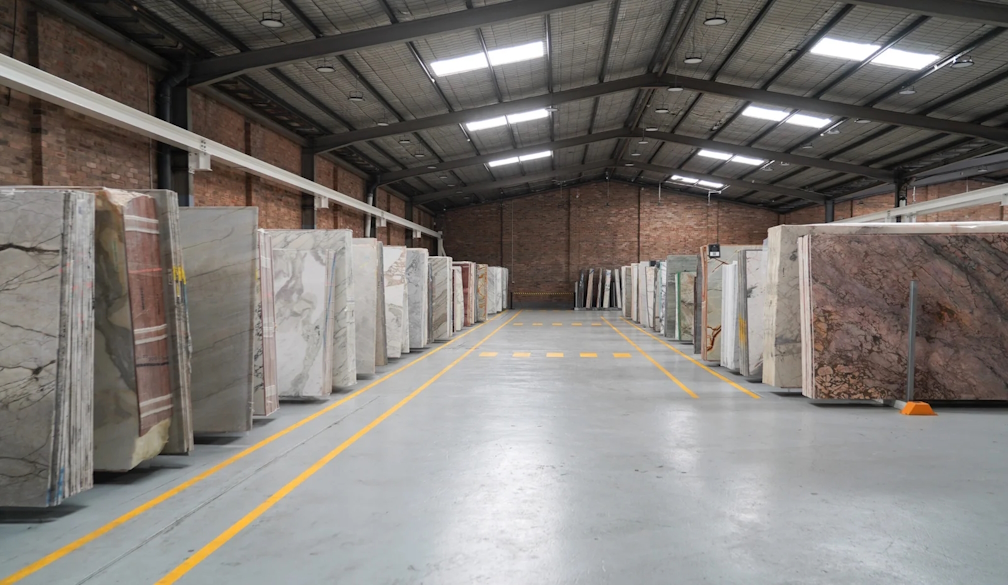
Part of the case for granite is the range that is now available. The traditional perception of granite as a black or brown speckled material is accurate as far as it goes, but the full range of granite is considerably wider. Slabs are available in grey, cream, blue, green, white, and warm toned options, many with significant movement and character rather than the uniform speckled pattern of older granite kitchen installations.
For homeowners who dismissed granite years ago based on the aesthetic of what was available at the time, revisiting the current range is worthwhile.
Frequently Asked Questions
Is granite harder than engineered stone? Generally yes. Granite sits at 6 to 7 on the Mohs hardness scale, while most quartz composite sits at around 7, making them comparable. However, granite's hardness is natural and consistent throughout the stone, while engineered stone hardness depends on the resin binder. In terms of heat resistance specifically, granite outperforms most quartz composite products.
Does granite need sealing if it is less porous than marble? Yes. Being less porous does not mean impermeable. A quality penetrating sealer protects against staining from oils, wine, and acidic liquids. Granite in a kitchen that handles regular cooking should be sealed at installation and resealed as needed, usually once a year based on a simple water bead test.
Can granite be used for an outdoor kitchen in Australia? Granite is one of the best natural stone options for outdoor kitchen applications in Australia. It handles UV exposure well, does not degrade in humidity or coastal air, and its heat resistance suits the demands of an outdoor cooking environment. It should still be sealed to manage staining from outdoor use.
Will granite crack if I place a hot pan on it? Granite's heat resistance is excellent and it is very unlikely to crack from a single hot pan placed on the surface. Extreme and rapid thermal shock over a very localised area, such as a blowtorch held directly on one spot, could potentially cause cracking, but this scenario is well outside normal kitchen use. Using a trivet is still good practice for protecting any stone surface.
What is the best way to clean a granite benchtop? Warm water and a soft cloth handle most daily cleaning. For heavier residue, a pH-neutral stone cleaner is the right product. Avoid bleach, vinegar, and ammonia-based cleaners, which can degrade the sealer and affect the stone surface over time.